The Week in Review: June 16th, 2026
THE COST OF MONEY, THE ABUNDANCE OF MONEY
Passing through Dulles Airport on Sunday, I ran into the head of another brokerage with whom I worked years ago and still greatly admire. Naturally, the conversation turned to business.
“How is it,” he asked, “that with a war, inflation, and interest rates where they are, the luxury market has never been better? Our sales are up 20% year-over-year.”
It’s a fair question.
We’ve spent much of this year discussing the “K-shaped economy,” where different segments of the population are having dramatically different economic experiences. One side of the K is contending with higher borrowing costs, elevated prices, and affordability challenges. The other is benefiting from rising asset values, strong business profits, and growing net worth.
That divide is showing up clearly in housing. For some buyers, mortgage rates remain a significant obstacle. For others, they are almost irrelevant. A household that has added millions of dollars to its balance sheet through business growth, stock appreciation, or liquidity events views the world very differently than a buyer stretching to qualify for a mortgage.
The result is a market that often appears contradictory. Luxury homes are selling briskly while affordability remains strained. High-end inventory is attracting competition while many buyers continue to wait on the sidelines for lower rates.
Inventory stands at just over one million homes nationally, essentially unchanged from a year ago and still indicative of a supply-constrained market. And when supply remains constrained, prices tend to rise.
Here in Washington, the story is particularly striking. The median sale price for a detached home reached $900,000 in May, an all-time high and the latest milestone in a decade-long climb.
Nowhere is the upper half of the K more visible than in places like San Francisco, where AI-driven wealth has fueled bidding wars. Yet even within Northern California, the story changes quickly. More rural and second-home markets such as Napa and Santa Cruz continue to feel the weight of higher borrowing costs and show softer negotiating dynamics.
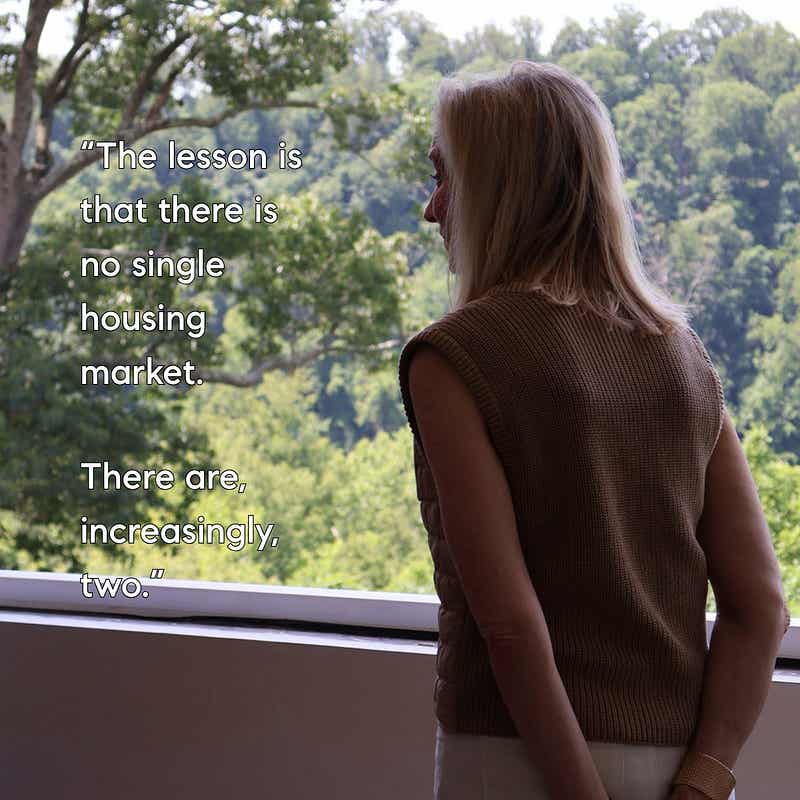
The lesson is that there is no single housing market. There are, increasingly, two.
One is driven by the cost of money.
The other is driven by the abundance of it.